Every few months, someone online claims that another Christian leader has “gone woke.” The phrase is now overused and vaguely defined, often thrown into social media debates. Recently, John Piper and Kirk Cameron have appeared in these discussions.

Yes, that John Piper. And that Kirk Cameron.

Who are They?

Piper is a Reformed Baptist theologian, retired pastor, and founder of Desiring God. Cameron, best known as the cheeky Mike Seaver from the 1980s sitcom Growing Pains, is now a vocal Christian activist and evangelist. Both are recognised as conservative voices in evangelical Christianity.

Why do people think they’ve “gone woke”? The answer reveals more about the strange moment the church currently faces than about Piper or Cameron. More on that soon.

Their Sins

On 26 February, John Piper posted a Bible verse on his X account: “You shall treat the stranger who sojourns with you as the native among you, and you shall love him as yourself, for you were strangers in the land of Egypt: I am the Lord your God.” Leviticus 19:34. Christians know the miserable bondage we were all in.

As for Kirk Cameron, he debated long-held beliefs in a chat with his son, James, discussing if the Bible teaches ‘eternal conscious torment’ or ‘annihilation’ of the soul—a controversy dubbed ‘Hellgate.’

Both men were accused of going woke.

Expanding Definition

Originally, “woke” meant staying alert to racial injustice in African American communities. Over time, it came to encourage supporting society’s marginalised.

Today, in some circles, “woke” has become shorthand for anything perceived as progressive, inclusive, or socially justice-oriented.

Within Christianity, “woke” has its own meaning. Pastors discussing racial reconciliation or poverty are seen as woke. Urging care for refugees, the environment, or injustice? Woke!

Sadly, a word that captures much of Jesus’ and Scripture’s teaching has been turned into an insult.

I’m Guilty Too

I feel for John Piper because all he did was post a bible verse, but the response from some Christians was harsh, equating him to a woke pietistic leftist. I made the same “mistake” on Facebook on 17 November, 2024. I posted a few Bible verses about our responsibility to care for foreigners, widows, and orphans and was accused of twisting scripture.

I responded, “Maybe I need to be more careful about which Bible verses I post. In future, should I stick to ones that don’t rattle cages, biases, and preconceived ideas?” I wonder if John Piper felt the same. I wrote this blog in response to the heated discussion.

Guilty Again

I also relate to Kirk Cameron, who admits he was caught off guard after his recent theological roundtable on the nature of hell sparked a wave of criticism—not from atheists, but from fellow believers. He says, “I really caught hell for this one, and I didn’t expect to get torched the way I did by guys on my own team.” He argued that if the church refuses to engage with these difficult topics, young people will turn to ‘Siri, Google, Grok, and ChatGPT’ for answers. ‘We would be foolish to think our children don’t have questions,’ he noted, calling on parents and leaders to provide a safe space for biblical inquiry.

I agree. Christians must get better at questioning beliefs, so long as core beliefs remain sacred. Eternal hell isn’t a core doctrine; Christians have debated the afterlife for centuries. Discussing these views isn’t heresy; it’s history.

What Else?

Along with fostering spaces for questions and healthy discussion, we Christians could benefit from offering more encouragement, especially on social media. I sometimes feel discouraged when I see fellow Jesus people using harsh language with one another. The fruit of the Holy Spirit includes qualities like kindness, gentleness, and self-control. Let’s strive for these even during disagreements.

We also need to recognise that sincere Christians hold different views on many topics and have done so since Jesus established the faith in the first century. For example, the early church fathers held varying perspectives on the afterlife, including eternal conscious torment (Tertullian, Augustine, Cyprian), conditional immortality (Ignatius, Irenaeus), and universalism (Origen, Gregory).

Christians have different views on creation, Revelation, the Lord’s supper, baptism, the cross (atonement theories), and many other doctrines. It’s helpful to read broadly, discuss with those who differ, and stay open to changing your mind. Reflecting Christ’s character is more important than winning arguments.

Strange Moment

And now, back to the strange moment the church currently faces, where respected figures like John Piper and Kirk Cameron are accused of being woke simply for quoting scripture or examining a Bible doctrine—and they’re not alone.

An American pastor faced criticism for preaching on the Beatitudes. Some of his parishioners labelled him as “weak” and “too liberal.” Yet, those statements are directly from Jesus and fundamental to our faith. Being meek, merciful, and loving enemies isn’t woke—it’s Christlike.

The Real Challenge

The challenge for Christians is to maintain conviction while showing compassion, to speak truth with humility, and to engage with culture without being shaped by it.

Whether you’re a theologian like John Piper, a public figure like Kirk Cameron, or just a believer trying to follow Christ in daily life, that tension is unavoidable.

And perhaps that’s exactly where the gospel does its best work. Because when Christians refuse to be defined by the loudest labels of the moment, they create space for something much more powerful: a faith grounded not in trends, but in truth.

Whenever there’s an election, I’m reminded of how little some sectors of the church have learned about the detrimental impact of polarising political statements made by churches and church leaders on the Gospel.

While I support Christians participating in politics or running for political office, the church as a whole—and pastors in particular—must remain above politics, nonpartisan, and committed to its central message: the good news of God’s love and grace through Jesus Christ. Anything that obscures that message is an enemy of the Gospel.

Too Political

Several years ago, the Barna Foundation commissioned research among young adults (ages 16-29) to determine why they did not engage with or had ceased to be involved in a church. One of the six reasons was that the church was “too political.”

I find it bewildering when church leaders make politically divisive statements, despite the evidence showing that this harms the cause of Christ. Sadly, we have observed a significant portion of the American church aligning politically, resulting in disturbing effects.

Conservatives Only?

A while ago, I saw a post on a pastor’s Facebook page encouraging his followers and congregation to “Let righteousness reign. Put Labor and the Greens last!” I realise this reflects the views of many conservative Christians, but my question is: what message does this send to people in that church who may disagree? What about people who do vote Labor or Green and still love Jesus? What about those in the broader community who are considering Jesus and the Church but are put off by this statement? Isn’t the Gospel inclusive, or do you have to change how you vote when you become a Christian? Also, why is it “righteous” to vote for a conservative party?

I don’t ask the people in our church who they vote for—it’s not my business—but I imagine we have all sorts of political perspectives at Bayside Church. Some of our members are conservative, while others have told me they’re voting for the Teals. Others are Green or Labor. People in our church are free to follow their conscience and vote accordingly. Our unity is found solely in the person of Jesus, whose kingdom is not of this world.

The Checklist

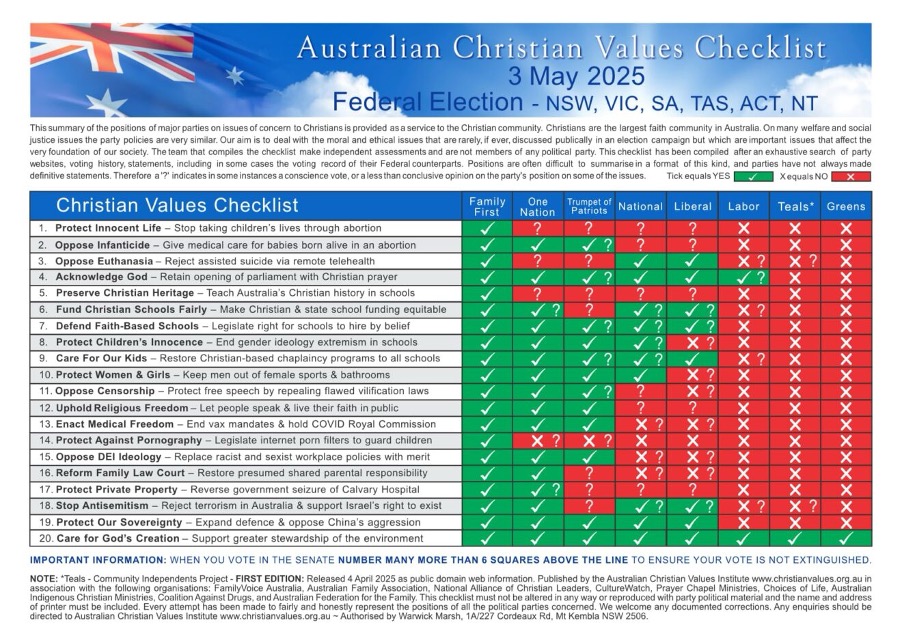
The aforementioned pastor shared the following chart compiled by the Australian Christian Values Institute.

The Christian Values Checklist informs voters about what each political party represents regarding various moral and ethical issues. The chart states, “On many welfare and social justice issues, the party policies are very similar. Our aim is to deal with the moral and ethical issues that are rarely, if ever, discussed publically [sic] in an election campaign.” I’ll return to that statement later.

The implication is that if you are a devoted Christian, you will likely vote for Family First, One Nation, or Trumpet of Patriots.

They Come and Go

In times past, the Australian Christian Values Institute has commended the Christian Democrats, the DLP, and Rise Up Australia. The Christian Democrats, Fred Nile’s party, were dissolved in 2022 by the courts due to longstanding legal challenges and governance issues. In the same year, the DLP (Democratic Labour Party) was deregistered because of a lack of members. Rise Up Australia was voluntarily deregistered by the Australian Electoral Commission in 2019. Rise Up’s leader, Danny Nalliah, has been surrounded by significant controversy for many years.

In 2025, we have some new parties to uphold “Christian values,” but if you can’t stomach any frontrunners, then the Nationals or the Libs would be your choice. However, whatever you do, “Let righteousness reign. Put Labor and the Greens last!”

Christian Values?

Let’s examine those Christian values. Predictably, they align with what one would expect from conservative Christianity in Australia, which has been significantly influenced by American Evangelicalism. In this tradition, the two main issues Christians should concentrate on are matters related to abortion and the LGBTQ+ community (stop both as much as you can).

While the chart helps you understand the various parties’ stances on these topics, I can’t help but notice the missing elements, which brings me back to the statement about welfare and social justice issues. Why separate these from a Christian Values Checklist?

Are refugees, the homeless, those living with mental illness, and victims of domestic violence not worthy of the Christian vote? Which party or parties have the best policies in place to help those on the margins of society? The chart includes nothing about those living in poverty, and it appears that the environment was added as an afterthought! Maybe I’m wrong, but is caring for God’s creation less critical than opening Parliament with a Christian prayer? And, on that topic, since when has it been a Christian value to force people to say a prayer if they don’t want to? Selah!

Jesus’ Example

For followers of Jesus Christ, He remains our example of Christian values. Jesus began and concluded His ministry with unequivocal value statements:

“The Spirit of the Lord is upon me, for he has anointed me to bring Good News to the poor. He has sent me to proclaim that captives will be released, that the blind will see, that the oppressed will be set free, and that the time of the Lord’s favour has come.”

At the end of his earthly ministry, Jesus proclaimed that his followers would care for the hungry and thirsty, the stranger, the naked, the sick, and those in prison.

You’ll notice the overlap in Jesus’ statements. It seems His heart for those struggling in life didn’t change during His ministry years, and it still hasn’t.

As you vote in this or any election, consider what is important to you, but don’t stop there. What about others, especially those on the margins? The people for whom Jesus mainly showed concern. Paul put it this way, “Don’t look out only for your own interests, but take an interest in others, too.”

Jesus said, “So in everything, do to others what you would have them do to you.” Being like Jesus means we will be interested in the people He showed interest in, such as those who are homeless, sick, or in prison; the poor, orphans, and widows; as well as those living with disabilities or who are victims of domestic violence.

Your vote should support candidates who implement policies that demonstrate care and concern for the most vulnerable members of our community, as well as for God’s creation.

A Final Word

The church and Christian leaders must remain non-partisan. The Gospel is good news for all people. The church does not thrive when in power; it’s not meant to rule nations or manipulate political systems. It’s intended to proclaim a message of reconciliation with a God who loves people and a Saviour who died and rose again to extend amazing grace. Let’s never lose this focus.