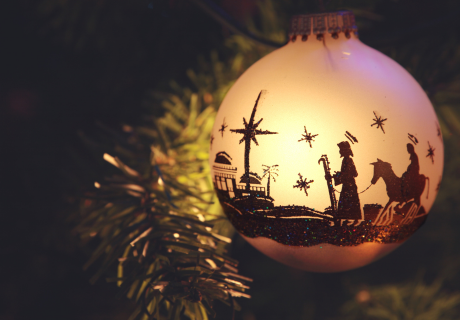
The Christmas story usually goes like this: Joseph and Mary arrive at the sleepy town of Bethlehem in the middle of the night. Mary is already in labour and sits on a donkey while Joseph desperately tries to find a room in one of the local inns, but he’s unsuccessful. Anxiously, he begs a reluctant innkeeper for any place where Mary could give birth to her baby. The innkeeper finally relents and makes room for them in a stable.
We get this story from a translation of a single verse in Luke’s Gospel: she brought forth her firstborn son, and wrapped him in swaddling clothes, and laid him in a manger; because there was no room for them in the inn.
But this differs from how Jesus was born, so let me clear that up.
What Really Happened?
Firstly, Joseph and Mary arrived in Bethlehem well before Mary gave birth. The Bible says, ‘While they were there, the time came for the baby to be born.’ So, they were already in Bethlehem. They didn’t arrive the night before.
Secondly, Joseph and Mary both came from the royal line of King David. Joseph was from Bethlehem and well known in the town. His extended family would open their homes—especially to a woman about to give birth.
So, what does the Bible mean when it says, “because there was no room for them in the inn”?
Wrongly Translated
The word translated as “Inn” in Luke’s gospel is elsewhere in the New Testament rendered as “guest room.” (Gk. Kataluma. Cf. Mark 14:14; Luke 22:11). There was no space for Joseph and Mary in the guest room because someone else was staying there.
Typical village homes in first-century Israel usually had a few rooms. One was the family room, where the household would live, cook, and eat during the day, then sleep at night. Next to it was a guest room.
At the end of the family room, steps led down to the stable. The mangers (feeding troughs) were positioned at the end of the family room so the animals could feed when they were hungry. There was no solid wall between the family room and the stable.
The New International Version gets the translation right: she gave birth to her firstborn, a son. She wrapped him in cloths and placed him in a manger because there was no guest room available for them. And so, Mary gave birth to Jesus in the family room of a private house, with one of the mangers making the perfect cradle for the newborn king. And then came the visitors.
The Visitors
The Shepherds were the first to learn about the Messiah. Shepherds ranked at the bottom of Israel’s social hierarchy. They were poor, unclean peasants, yet they were asked to be the first to visit Jesus. They might have been scared, wondering how those at the lowest rung of society would be treated. But the angel said to them, “Do not be afraid. I bring you good news that will cause great joy for everyone. Today, in the town of David, a Saviour has been born to you; he is the Messiah, the Lord. This will be a sign to you: You will find a baby wrapped in cloths and lying in a manger,” just like a normal baby in a regular house.
Jesus came for the poor, the lowly, and the rejected – but he also arrived for the wealthy and wise. The subsequent guests (probably a year or so later) were the wise men from the East, students of the planets and stars. The wise men were possibly wealthy Gentiles from Arabia, the only place where the trees grew that yielded Frankincense and Myrrh. Gold was also mined in Arabia, and only the rich would own it.
A Fascinating Story
In the 1920s, a British scholar, E.F.F. Bishop, visited a Bedouin tribe in Jordan. The Muslim tribe was called al Koka Bani, meaning “Those who study or follow the planets.” Bishop asked the tribal elders why they called themselves by that name. They told him it was because their ancestors had followed the planets and travelled west to Israel to honour the great prophet Jesus at his birth.
So, the birth of Jesus the Messiah broke down all the barriers between people: Rich and poor, Jew and Gentile, royal and lowly, male and female, slave and free – and that’s what we celebrate when we think of the birth of Jesus today.
When God entered the human world, it was to welcome everyone without exception. No wonder all of heaven rejoices. May we celebrate too.